For the Whole Body
Church Health Assessment.
We want to help your church be as healthy as it can be and flourish — biblically contextualizing your ministries to a dynamic and rapidly evolving culture.
Why It Matters
The purpose of the Church Health Assessment.
We want to help your church to be as healthy as it can be and flourish. The task is to biblically contextualize your church's ministries to a dynamic and rapidly evolving culture. The purpose of our Church Health Assessment is to help the church:
- Discover areas of ministry that are strong and capitalize on them
- Discover areas that need attention and address them
- Lessen the loss of momentum
- Discover how to mine the potential of your ministries
- Chart a path toward health and kingdom growth
- Experience more joy and fruitfulness in ministry
A Word for Our Moment
"The world in front of you is nothing like the world behind you."
Now it is even more volatile, uncertain, complex, and ambiguous.
Tod Bolsinger
How We Work
The Process.
A comprehensive examination using applied analytics based on scientific research and hundreds of proven data points, plus the experience of veteran church leaders.
An 18-month engagement
Month 1 → Month 18- Engage
Months 1–2
Leadership meeting, context discovery, and a curated statement of work.
- Gather
Months 2–6
Congregational and leadership assessments, on-site interviews, and data synthesis.
- Align
Months 6–8
On-site reporting and facilitated strategy design with your leadership team.
- Coach
Months 8–18
Team workshop, twelve months of pastoral coaching, and quarterly strategic reviews.
What We Measure
The ten indicators of health.
Every assessment is built on ten proven identifiers of church health, shaped by decades of research and practice — including Natural Church Development (Christian Schwarz), Nine Marks of a Healthy Church (Mark Dever), Becoming a Healthy Church (Stephen Macchia), and Shaped by the Gospel (Tim Keller).
Gospel Doctrine
Does the church's teaching consistently reflect a clear, biblical understanding of who God is, humanity's need for salvation, and the redemptive work of Christ — shaping members to repent, trust Him, and live in response to the gospel?
Practicing Prayer and Providence
Is corporate prayer foundational, and does the church genuinely rely on God's guidance — turning challenges into opportunities for growth, unity, and gospel impact?
Effective Discipleship and Formation
Does the church equip members of all ages with resources and training for daily spiritual growth, fostering a culture where joyful devotion translates into action?
Cultural Care and Unity
Do members tangibly support one another and their pastors across diverse backgrounds, or do gaps exist in meaningful connection and care?
Vision Clarity
Is the church's God-given mission, vision, and values clearly defined, widely embraced, and actually guiding decisions and actions?
God-Exalting Worship
Do gatherings engage mind, soul, and strength in glorifying God — inspiring genuine response shaped by His Word and Spirit?
Gift-Oriented Serving and Groups
Do members experience deep connection, vulnerability, and growth, serving in ways that align with their gifts and strengthen the whole body?
Servant-Leadership Empowerment
Does the church identify, develop, and equip people with leadership gifts — cultivating leaders who empower others rather than merely recruiting helpers?
Biblical Structure
Is leadership Christ-centered, respectful of congregational authority, and faithfully exercised by qualified leaders in a way that advances the church's vision?
Need-Oriented Multiplication
Is there a clear strategy for communicating and demonstrating Jesus' truth and love beyond the church walls — reproducing disciples, groups, and churches?
Start free
Two ways to begin.
Not ready for a full engagement? Both of these are free, take minutes, and give you something useful today.
Self-check
How healthy is your church?
Five minutes and ten honest statements. You'll get a clearer picture of where your church is thriving — and where to focus next.
- Ten indicators of health
- Instant snapshot of your results
- Free · No signup required
Know your community
Who has God placed around your church?
A complimentary demographic report for your neighborhood — household makeup, life stage, beliefs, and felt needs.
- Census-backed household & income data
- Spiritual climate & felt-needs narrative
- Delivered free to your inbox

Talk to Stephen
See how a Church Health Assessment could benefit your church.
Stephen, our VP of Church Health, is ready to discuss the Church Health Assessment — how it works and how it can benefit your congregation. Whether your church is flourishing or needs support, our tailored process provides guidance.
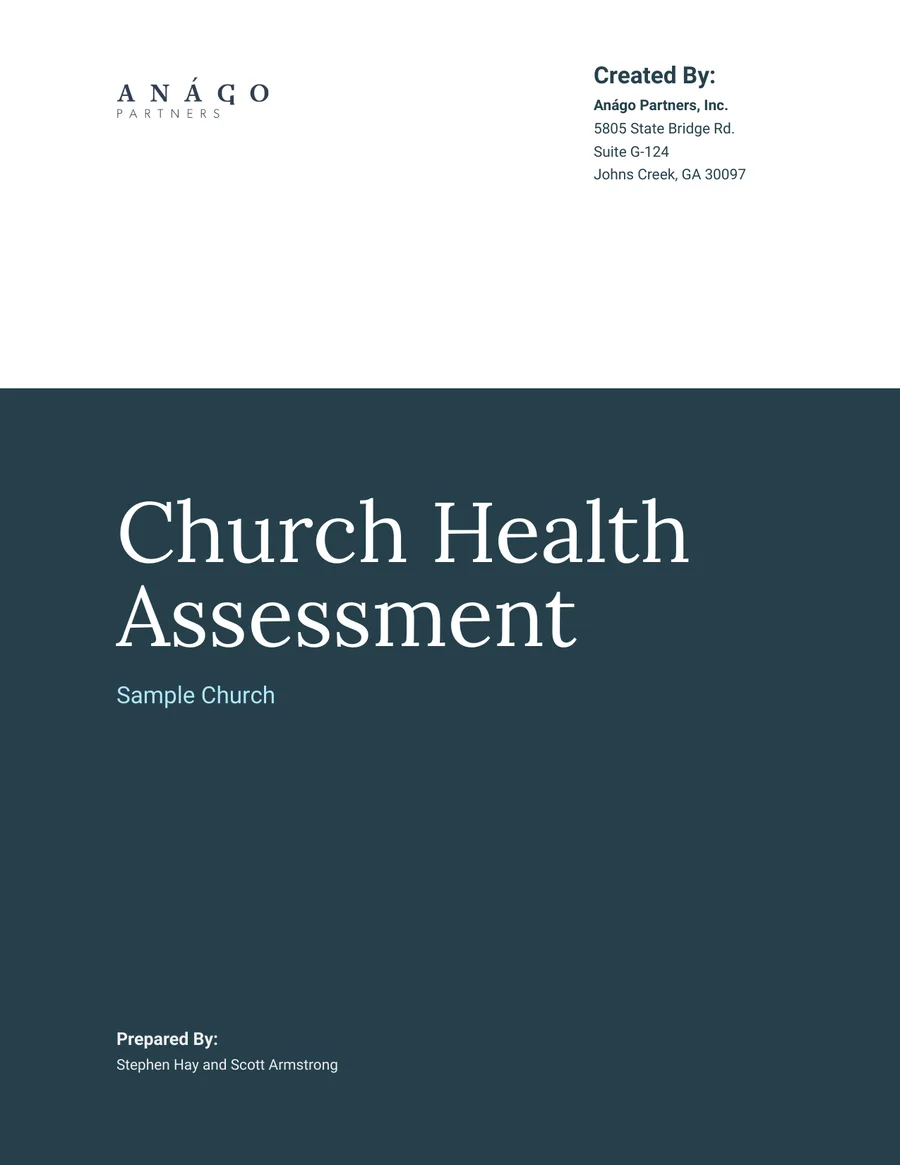
Sample report cover. Identifying details removed.
See It First
Preview a sample assessment report.
Before you begin, look at what a completed Church Health Assessment actually produces. This is a real report format, prepared for a sample church, with the church's identifying details removed.
- Congregational survey results with clear scoring across each health domain
- Demographic study of the surrounding community and what it means for ministry
- Assessor observations from interviews and the onsite visit
- Prioritized recommendations your leaders can actually act on
Want to see how your church would interact with findings over time?
Explore the sample Church Health portalWe’ll email you the link too. PDF, about 2.7 MB.
Common Questions
How to assess church health.
How do you assess church health?
You assess church health by gathering honest data from more than one vantage point and then reading it together. In practice that means four steps: prepare (name what you actually want to learn and who needs to be in the room), gather (congregational surveys, leadership interviews, demographic study of your community, and an onsite visit), report (put the findings in front of your elders and staff without softening them), and implement (choose two or three priorities and build a plan with owners and dates). A church health assessment is not a grade; it is a shared picture that makes the next faithful step obvious.
What church assessment questions should we be asking?
Strong church assessment questions cover five areas: mission clarity (can a member describe why this church exists in one sentence?), discipleship pathway (what is the visible next step for a new believer?), leadership pipeline (who is being formed to lead in the next three years?), pastor and staff health (is our pace sustainable, and who would tell us if it wasn't?), and outward posture (would our neighborhood notice if we closed?). Ask each question of the pastor, the elders, the staff, and the congregation separately — the gap between those answers is usually the most useful data you'll get.
How often should a church assess its health?
A short self-assessment is worth doing every six to twelve months, ideally with your elders or staff answering separately before you compare notes. A deeper, outside-led assessment makes sense at a transition point — a pastoral change, a plateau you can't explain, a building or budget decision, or the start of a new season of vision.
What is the difference between a quick church health snapshot and the Church Health Assessment?
Our free 10-statement snapshot takes five minutes and is meant to start a conversation among your leaders. The Anágo Church Health Assessment is a guided engagement: surveys, interviews, community demographic research, an onsite visit, a written report, and support as you implement the priorities that come out of it.
Who should be involved in assessing church health?
At minimum, the lead pastor and the elders or governing board. Better assessments also include staff, ministry leaders, and a cross-section of the congregation — newer members especially, because they can still see what long-time members have stopped noticing. An outside voice helps most where a church has developed language for its problems that keeps it from naming them plainly.
What are the signs of an unhealthy church?
Common signals include mission drift (activity without a clear why), a discipleship path that stops at attendance, leadership that can't be handed off, conflict that gets managed rather than resolved, a pastor running on fumes, and steady decline in engagement that no one is allowed to discuss openly. None of these are terminal — but they don't correct themselves without honest assessment and a plan.